June 2025 Newsletter
Veteran Graduates Receive their Stoles
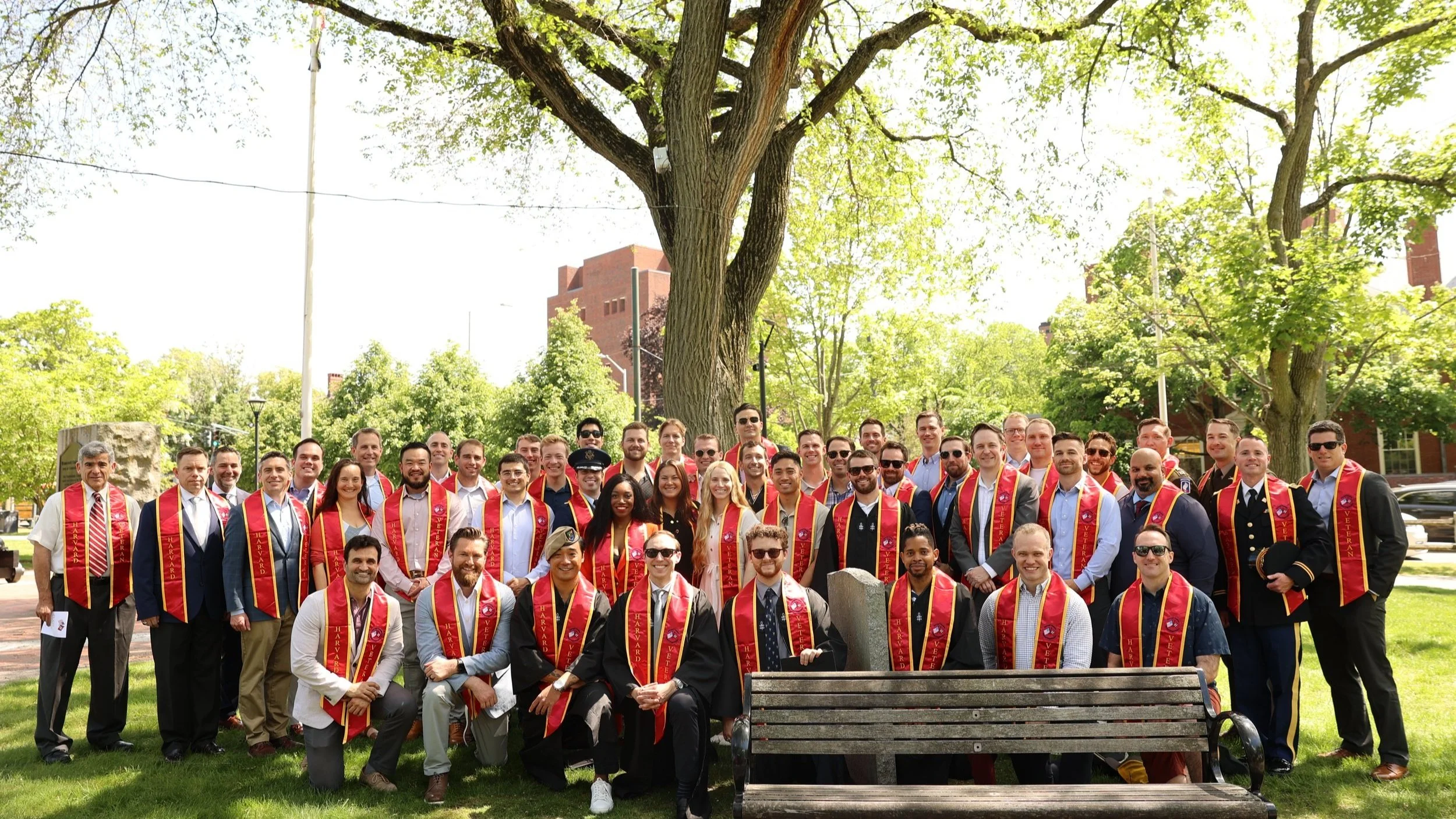
Tuesday, May 27th, the Harvard Veterans Alumni Organization (HVAO) and the Harvard Extension Veterans Student’s Organization (VSS) hosted the annual Veteran Graduation Ceremony. Held at the historic First Church in Cambridge, the ceremony welcomed over 100 veterans from across all of Harvard’s schools into the “Long Crimson Line”—a proud tradition that recognizes the enduring service and sacrifice of veterans in the Harvard community.
Each graduating veteran was presented with a crimson stole to wear at commencement, symbolizing both their academic achievement and their military service. The ceremony featured the presentation of the colors by the Color Guard from the USS Constitution and a keynote address from Navy veteran and Harvard faculty member, Dr. Eric Goralnik. VSS President Mike Lupia served as Master of Ceremonies, and HVAO Vice President Lydia Rossman rounded out the program by welcoming graduates into the alumni organization. Together, they reflected on the meaning of service, the strength of the veteran community, and the unique journey each veteran has taken to arrive at this moment.
Following the ceremony, graduates gathered under the Washington Elm in Cambridge Common for a commemorative photo. This historic site marks the place where General George Washington assumed command of the Continental Army in 1775, a fitting backdrop for a new generation of leaders who have served their country and now prepare to serve in new ways.
The ceremony highlighted the powerful legacy of military service at Harvard and the bonds that connect veterans across generations. As these graduates move forward, they carry with them not only the education they earned but the honor of continuing a tradition of service, leadership, and resilience.

USS Constitution Color Guard
The USS Constitution Color Guard presented the colors at the Veterans Graduation Celebration.
Color Guard members are: YNS2 Jones, AD2 Davis, QM1 Guenther, and AN Collinsnelson.
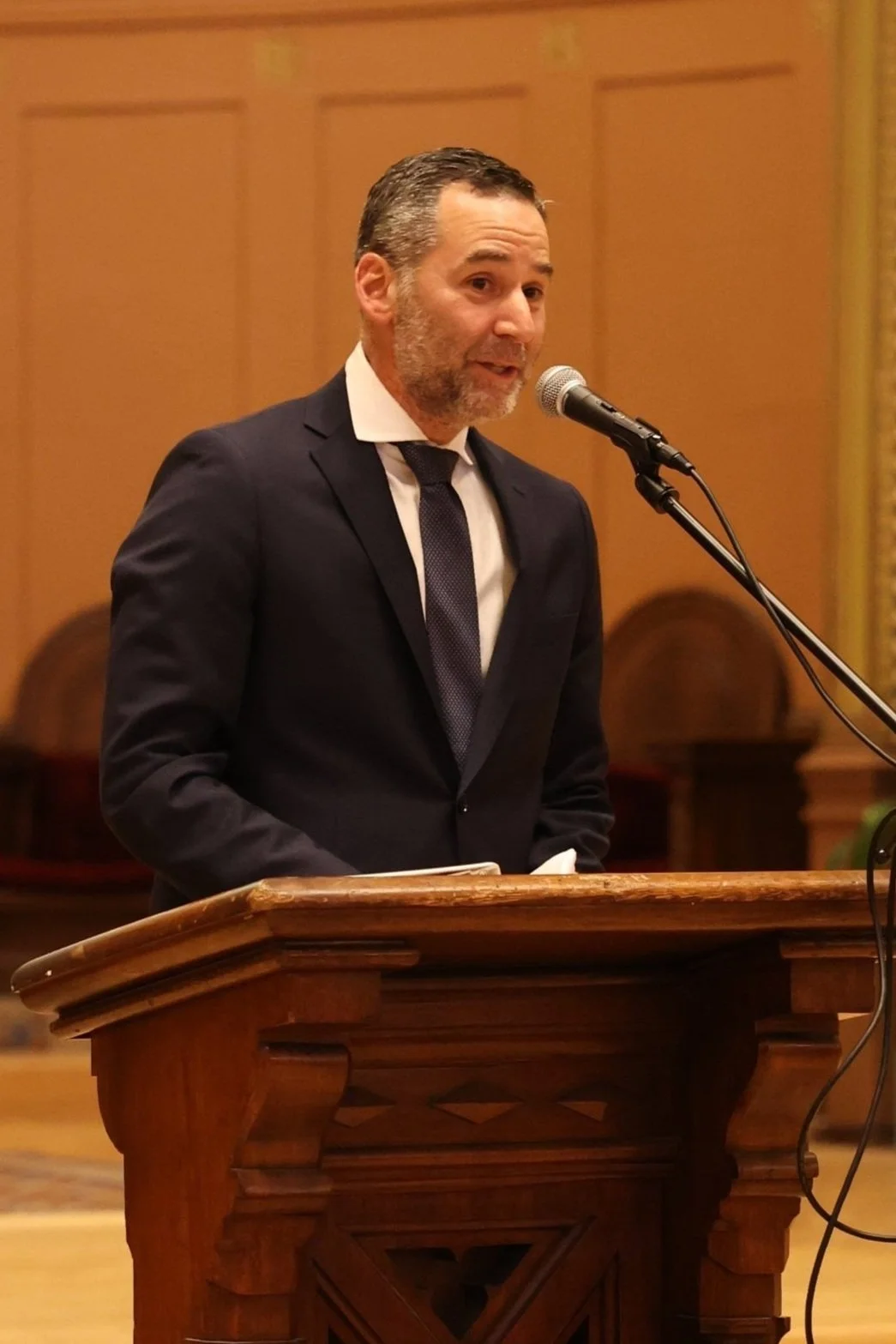
Naval Academy graduate and Harvard faculty member, Dr. Eric Goralnik, gave the keynote address to graduates.
Dr. Goralnik reflected on the merits of failure in the journey to success and gave graduates five lessons from the emergency room to live by.
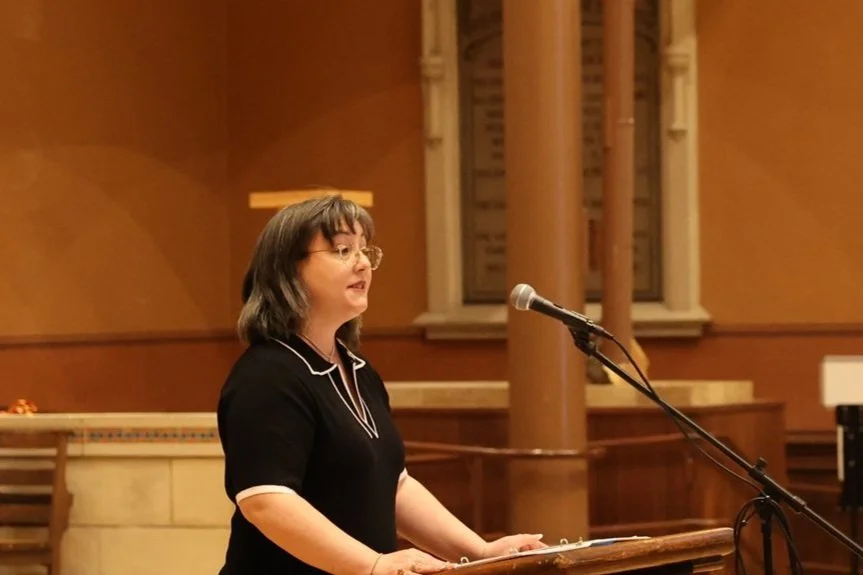
Harvard Veterans Alumni Organization Vice President, Lydia Rossman, congratulated graduates on the results of their hard work and welcomed them into the ranks of the Long Crimson Line.

250 Years of Independence
As the United States marks the 250th anniversary of the American Revolution, it is an opportune moment to reflect on the intertwined legacies of George Washington and Harvard University—two pillars of the nation's founding era. Washington’s relationship with Harvard is emblematic of the shared ideals and mutual respect that helped shape the emerging republic.
In July 1775, shortly after being appointed Commander-in-Chief of the Continental Army, George Washington arrived in Cambridge, Massachusetts, to take command of colonial forces. His headquarters were established in Wadsworth House, a building on Harvard’s campus. The University was already a bastion of revolutionary thought and had seen many of its alumni and faculty join the patriot cause.
Washington's presence at Harvard symbolized the alignment between military leadership and intellectual authority in the fight for independence. In recognition of his leadership and principles, Harvard conferred an honorary Doctor of Laws degree upon Washington in 1781—its first to a non-graduate military figure. This gesture reflected the university’s commitment to the ideals of liberty, civic virtue, and republican governance that Washington so powerfully embodied.

One of the enduring symbols of Washington’s time in Cambridge is the Washington Elm, believed to have stood near the spot where Washington took command of the Continental Army on July 3, 1775. Though the original tree no longer stands, its memory is preserved through a commemorative marker and a descendant elm planted in its place. The Washington Elm serves as a living monument to the birth of the American military and Harvard’s proximity to this transformative moment in history.
Two and a half centuries later, the relationship between Washington and Harvard serves as a poignant reminder of the enduring legacy of the American Revolution. Both the man and the institution contributed to the creation of a nation founded on Enlightenment values and democratic aspirations. As the country commemorates 250 years of independence, honoring the convergence of leadership and learning embodied by Washington and Harvard offers a powerful narrative about the founding and future of the American experiment.
Honoring Those Who Gave All
HVAO Cleans the Vietnam Memorial in Washington D.C.
On Saturday, May 31, a group of Harvard Veterans gathered in Washington, D.C. to pay tribute to and honor those who were lost during the Vietnam conflict by washing the Vietnam Memorial Wall. Joined by three of our own Vietnam veterans, Tom Reardon, John Simpson, and Josh Lanier, we washed the wall together in quiet reflection and deep gratitude. The spirit of the day was clear: remembrance, respect, and unity. Surrounded by the names of the fallen and the memories they carry, we honored their legacy with every gentle touch of the stone, ensuring they are never forgotten.
Harvard University lost 22 graduates during the conflict in Vietnam. They are George William Casey, Richard Rich, Pieter Ronald van Thiel, Joseph Bion Philipson, Jr., William Newcomer Feaster, Robert Roy Little, Lewis Metcalfe Walling, Jr., James Gable Dunton, William Emerson, Wilson Fitzgerald Halley, Joseph Thomas McKeon, Jr., Edward William Argy, Langdon Gates Burwell, Peter Wyeth Johnson, John Bernard Martin II, Charles Edward Ryburg, Michael Nelson Loitz, Christopher Warren Morgens, Carl Spaulding Thorne-Thomsen, Nelson Ramon Morales, Robert Charles Murray, and Melvin Lederman.

Members of HVAO gather at the Vietnam Memorial Wall in Washington D.C..
Harvard university - a hotbed of revolutionary thought

During the American Revolution, Harvard University’s longstanding academic legacy intersected with the urgent demands of wartime, making the institution a vital asset to the revolutionary cause. Founded in 1636, Harvard was already deeply embedded in the fabric of colonial society by the time hostilities broke out. In a bold demonstration of civic responsibility, the university dismissed its students early and ceded its campus to the Continental Army, transforming its grounds into a strategic base of operations.
This act of sacrifice signaled Harvard’s alignment with the rebellion, not just as a passive observer but as an active participant in the nation’s birth. The presence of a Dunlap broadside copy of the Declaration of Independence in Harvard’s Houghton Library—a rare artifact dispatched by John Hancock to General Artemas Ward—further cements the university’s direct connection to the revolutionary leadership and pivotal moments of 1776.
Beyond its physical contributions, Harvard's ideological influence loomed large in shaping the revolutionary ethos. The university’s alumni filled key roles in the Continental Congress, with eight signers of the Declaration of Independence tracing their roots to Harvard. Figures such as John Adams and Samuel Adams became foundational voices in the call for independence, drawing from the classical and philosophical education they received in Cambridge. Samuel Adams, in particular, channeled his academic background into revolutionary theory; his thesis boldly endorsed the right to resist tyranny, reflecting an early alignment with the principles that would animate the revolution. These intellectual currents within Harvard cultivated a generation of thinkers and leaders who would ultimately articulate and defend the American cause with clarity and conviction.
The individual stories of Harvard graduates underscore the university's role as an incubator for dissent and political leadership. John Hancock, a 1754 alumnus and former treasurer of the university, emerged as a prominent revolutionary and the first signer of the Declaration, despite a tumultuous tenure in university finance. Elbridge Gerry’s master's dissertation opposing the Stamp Act typified the academic resistance to British overreach, linking scholarly critique to broader colonial defiance. These examples reflect how Harvard's academic environment fostered intellectual growth and a strong sense of civic duty and political courage. As both a bastion of revolutionary thought and a logistical supporter of the war effort, Harvard University stood at the intersection of scholarship and statecraft, leaving an indelible mark on the founding of the United States.
The Harvard Veterans Alumni Organization newsletter is a publication of the Harvard Veterans Alumni Organization, Inc.. HVAO retains all rights to the content contained therein.
Staff Writer: Joslin Joseph, ALM ‘25